Over 50,000 Infected! Ancient "Whooping Cough" Resurges—Is the Vaccine No Longer Effective?
An ancient infectious disease has returned, with the peak incidence shifting from infants and young children to adolescents and adults.
The latest data released by the National Disease Control and Prevention Administration shows that in the first quarter of 2024, China reported 59,458 cases of pertussis (whooping cough), with 13 fatalities - a 26-fold increase compared to the same period in 2023 (2,241 cases).
It is estimated that the reported cases in China in 2024 may become the highest in the past 37 years.
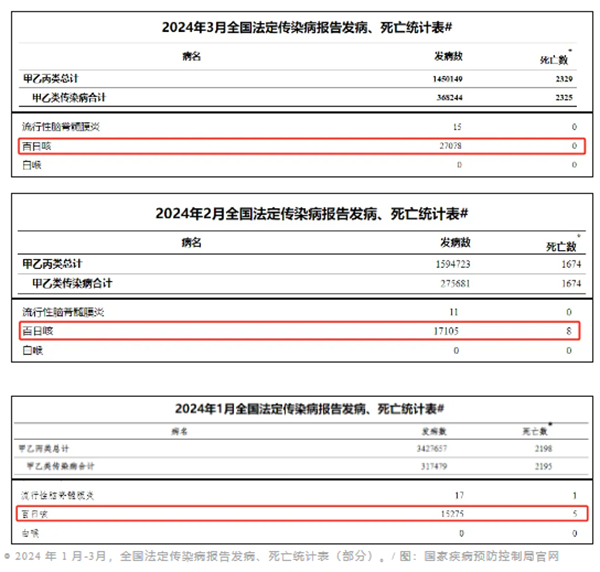
Since January this year, the number of pertussis infections has been steadily increasing. The National Disease Control and Prevention Administration released the latest overview of national statutory infectious disease epidemics on April 22, with striking data reminding us again: pertussis infections are not declining, with March infections reaching 27,078 - nearly 10,000 more cases than the previous month.
In top-tier hospitals, outpatient physicians have keenly observed that pertussis has become somewhat different from before: not only has there been a significant increase in older pediatric cases, but adolescents and adult pertussis patients also present with "atypical" symptoms. Even when seeking treatment for persistent coughing, many patients are misdiagnosed with bronchitis or mycoplasma pneumoniae pneumonia.
Ms. Du (pseudonym) from Guangzhou, who was not diagnosed in time, has been coughing for 10 days. At times, the cough is so severe she can barely breathe, feeling as if her lungs might be torn out. When she visited a tertiary hospital, "after blood tests and imaging examinations, I was diagnosed with bronchitis. But after two weeks of medication, there was no significant improvement. I then consulted the respiratory department, where the doctor said many viruses simply cannot be detected and told me to continue with the previous treatment plan—taking azithromycin. Knowing about the recent pertussis outbreak, I mentioned it casually. Unexpectedly, the nasopharyngeal swab PCR test for pertussis came back positive..."
The incidence of pertussis is likely severely underestimated because China has yet to establish comprehensive active surveillance for the disease. Given this growing trend, clinicians should be more proactive in screening to identify more pertussis cases.
Higher Transmission Than COVID: Pertussis Surges in Countries With High Vaccine Coverage
Pertussis, an acute respiratory infectious disease caused by Bordetella pertussis, is named "whooping cough" because its course can last two to three months.
It is one of the most contagious diseases known to humankind, with infectiousness only slightly lower than measles. Research shows that the early COVID-19 virus had a transmission rate of approximately 6 people, while whooping cough spreads to 11-17 people, and measles can reach 12-18 people.

◎After a child in the next bed at kindergarten had whooping cough, their own child was unfortunately diagnosed with it too./ Source: Xiaohongshu @漂流瓶
This disease is universally susceptible in the population, particularly prevalent among children under 5 years old, and was once one of the leading causes of infant mortality worldwide until the successful development of a vaccine in 1974 brought it under effective control.
In 1978, China first incorporated the whole-cell pertussis-containing diphtheria-tetanus-pertussis (DTP) combined vaccine into the national childhood immunization program. Since 2007, there has been a gradual shift to using acellular pertussis-containing diphtheria-tetanus-pertussis (DTaP) vaccine, and by 2013, the DTaP vaccine was fully implemented. The reported vaccination rate for the three doses of DTaP vaccine has remained above 99%.
Over the past three decades, widespread vaccination has protected countless Chinese children from pertussis infection, and even when infections occur, symptoms tend to be milder. Xu Ran (pseudonym), a mother born in the 1980s, remarked, "Pertussis is a very ancient disease. My younger sister contracted it as a child when rural healthcare conditions were poor and there was little awareness of vaccination. But now things are different—health is prioritized. Both of my children receive all vaccines included in the national immunization program on schedule, including the DTaP vaccine."
Who would have thought that long-dormant pertussis would resurge? Even more surprising is that many countries with high vaccine coverage worldwide are experiencing a sharp spike in pertussis infections:
From January to March this year, the number of reported cases in the Czech Republic has exceeded 3,000, reaching the highest level since the 1960s.
On March 27, data released by the Philippine Department of Health showed that the country has reported 40 deaths from whooping cough this year.
Countries including Australia, the United States, the United Kingdom, Greece, Denmark, Belgium, Norway, Spain, and Sweden are also in an epidemic period of whooping cough, with a surge in infections.
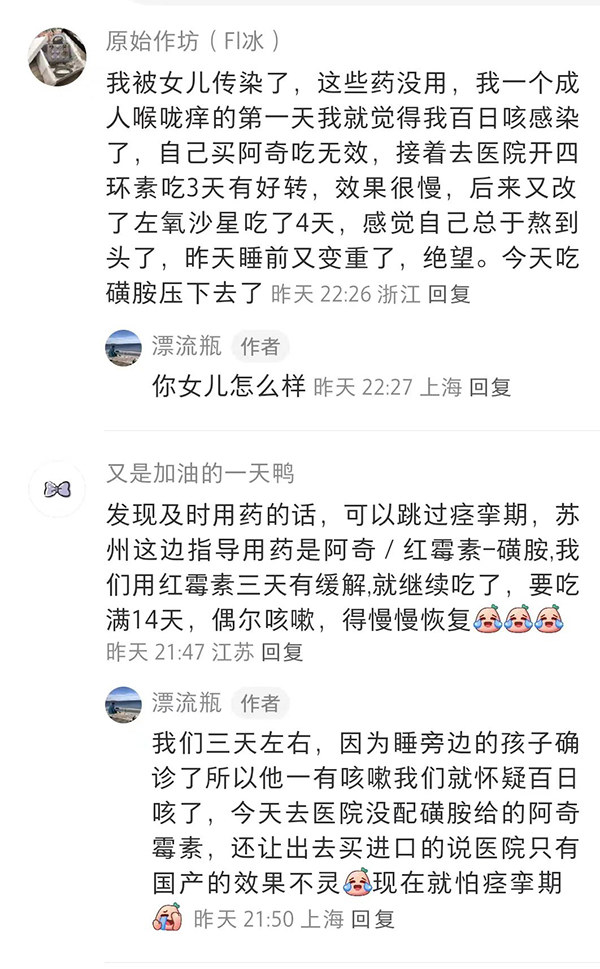
◎A mom contracted whooping cough from her daughter./ Image source: Xiaohongshu @漂流瓶
The explosive growth of whooping cough cases and reported deaths has also raised alarm among China's disease control authorities. From January 1 to March 31 this year, 59,458 cases of whooping cough were reported nationwide - 26 times the number during the same period in 2023 (2,241 cases), with 13 reported deaths. The data growth remains striking.
Surveillance data shows that whooping cough incidence in China had been on an upward trend for over a decade, but the current growth momentum has become increasingly rapid.
"Therefore, whooping cough prevention and control in our country now requires high-level attention," said Shen Hongbing, academician of the Chinese Academy of Engineering and director of the Chinese Center for Disease Control and Prevention, at the "2024 Vaccine and Immunity Conference".
At this point, whooping cough has entered a situation of global prevalence.
Has the original vaccine failed? Urgent need to update vaccination strategies
Why is there a widespread global resurgence of pertussis? The reasons are multifaceted, including increased awareness and attention from healthcare professionals, improved sensitivity in symptom monitoring, the application of detection technologies such as polymerase chain reaction (PCR), and factors like neither natural infection nor vaccination providing lifelong immunity and bacterial strain variations.
It cannot be denied that compared to previous methods such as bacterial culture and PT antibody testing, current pertussis diagnostics now include nucleic acid testing, and the number of hospitals or institutions capable of performing diagnostic tests has significantly increased. This may contribute to some extent to the rise in confirmed cases.
However, experts mention gaps in the pertussis vaccination schedule and the insufficient durability of vaccine-induced immunity, which clearly strikes a more sensitive chord with the general public.
Currently, China's free vaccination program for children against pertussis (whooping cough) uses the "DTaP vaccine" (Diphtheria, Tetanus, and acellular Pertussis combined vaccine) in a total of 5 doses. The vaccination schedule is as follows: one dose each at 3 months, 4 months, 5 months, and 18 months of age, with a final dose of DT vaccine (Diphtheria and Tetanus) administered at 6 years old.
Clearly, this regimen cannot effectively protect immunocompromised newborns. Regarding this issue, foreign countries have more proactive prevention strategies. For example: newborns begin receiving the DTaP vaccine at birth, with the first three doses completed within three months after birth. In the UK and US, pertussis vaccination is not only given to young children but also requires booster shots before entering kindergarten or elementary school, and during pregnancy.
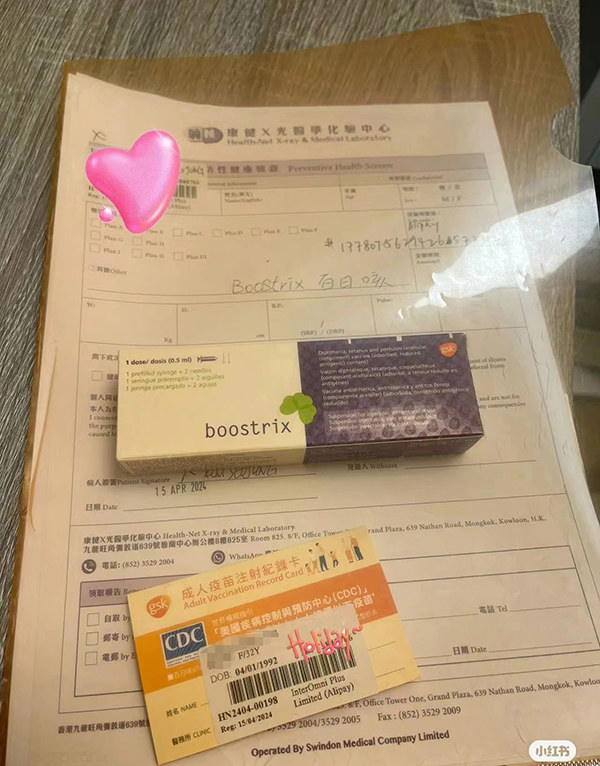
◎Due to the recent outbreak of whooping cough, I rushed to Hong Kong at 36+ weeks of pregnancy to get the whooping cough vaccine, ensuring my baby would be born with antibodies. / Source: Xiaohongshu @Lyrical in Shenzhen
The pertussis vaccine does not provide lifelong immunity, especially for older children and adults. Immunity diminishes over time after vaccination, leading to insufficient protection against pertussis in the majority of people in China aged 7 and above. However, China has yet to develop a pertussis vaccine specifically for adults.
According to Dou Zhifang, Deputy Director and Chief Physician of the Department of Respiratory and Critical Care Medicine at Aviation General Hospital, neither vaccination nor natural infection with pertussis confers lifelong protection. Vaccine-induced pertussis-specific antibodies typically last between 4 to 12 years. As vaccine efficacy declines in adolescents and adults, reinfection becomes possible. Since symptoms are often mild in these cases, infected individuals may become hidden sources of transmission.
The World Health Organization estimates that in recent years, there have been 50 million cases of pertussis globally each year, resulting in 300,000 deaths, with 95% occurring in developing countries. The transmission pattern of pertussis has shifted from the traditional "child-adolescent/adult" model to an "adolescent/adult-child" model.
The medical community believes that vaccination remains the most cost-effective means of preventing and controlling pertussis by reducing the risk of severe illness and death. Faced with the rising incidence of pertussis, Shen Hongbing noted, "We should consider whether our immunization policies need adjustment and what improvements or optimizations are required for the vaccines."

Chinese Guidelines for Diagnosis and Treatment of Pertussis (2024 Edition) / Image source: Chinese Medical Journal
The newly released "Chinese Guidelines for Diagnosis and Treatment of Pertussis (2024 Edition)" (hereinafter referred to as the "Latest Pertussis Diagnosis and Treatment Guidelines") clearly states that the international experience of developed countries in effectively controlling pertussis epidemics by implementing immunization strategies for booster vaccination against pertussis in school-age children, adolescents, adults, and pregnant women requires more research evidence from China to provide policy support. At the same time, it emphasizes the need to accelerate the domestic development of pertussis-containing vaccines for adults to promote China's progress in controlling the resurgence of pertussis.
With the high drug resistance rate of pertussis, what alternative treatments are available?
Behind the surge in pertussis cases lies an issue that cannot be ignored: the high drug resistance rate of Bordetella pertussis, which poses significant challenges to current treatment protocols.
Studies show that the resistance rate of Bordetella pertussis strains isolated from pertussis patients in China to macrolide antibiotics has reached as high as 70%-100%. Similarly, reports from multiple countries including the United States indicate high resistance rates to macrolide antimicrobial drugs.
39 Deep Breath has learned that the current preferred treatment regimen for pertussis involves antimicrobial therapy, with macrolide antibiotics such as azithromycin, erythromycin, roxithromycin, or clarithromycin being the first-choice antimicrobial agents for both treatment and prevention.
However, since macrolide antibiotics like azithromycin and erythromycin are also commonly used to treat respiratory infections such as bronchitis and mycoplasma pneumonia, these drugs have developed resistance among certain populations in China, resulting in limited effectiveness against pertussis treatment.
Therefore, the latest diagnostic and treatment guidelines for pertussis recommend that hospitals with adequate facilities perform Bordetella pertussis culture and drug susceptibility testing before and after antimicrobial treatment to confirm whether the patient is resistant to macrolide antibiotics.
For pertussis patients resistant to macrolide antibiotics or those who do not respond to empirical macrolide therapy, the guidelines recommend: For children above 2 months of age and adults, the first-line treatment should be compound sulfamethoxazole (sulfamethoxazole + trimethoprim); For infants aged 2 months or younger, cefoperazone-sulbactam or piperacillin-tazobactam is recommended, with levofloxacin serving as an alternative option for adult patients.
Always follow medical guidance for safe medication use and avoid self-medication. Dr. Zeng Jun from the Pediatric Outpatient Department of Guangzhou Women and Children's Medical Center explained that most pertussis cases can be effectively controlled within one month and do not require "100 days of coughing." If infected with pertussis, immediate isolation measures should be implemented to prevent transmission to children—wear masks, wash hands frequently, and ensure proper home ventilation.
(All patient names in this article are pseudonyms)