What effect does prolonged sitting have on men? You may be underestimating its "lethality"
Recently in the clinic, a man in his thirties came to see me. He said he sits in the office for more than 10 hours every day, and after he gets home he basically “sits without moving.” As a result, in the past few months he began experiencing frequent urination, a feeling of incomplete emptying, persistent lower abdominal heaviness, increased nighttime urination, and a noticeably diminished performance during sex. He said, “Director Yuan, I'm still so young—how could I have prostate problems?”
I only asked one question: “Have you been sitting for long periods?”
He paused in surprise, then nodded.
In fact, the impact of prolonged sitting on men's health is far more serious than people think. Especially now, with more and more computer workers, office workers, and frequent drivers, problems caused by "sitting" really should not be underestimated.
01 The prostate is a major casualty of prolonged sitting
The prostate sits below the bladder and surrounds the urethra; it is an important organ unique to men. Long-term sitting impairs blood circulation in the pelvic area, leaving the prostate in a prolonged state of "high pressure" and "low oxygen." Metabolic waste cannot be cleared and nutrients cannot be delivered properly, making inflammation very likely to develop.
Typical symptoms of prostatitis, besides frequent urination, urgency, and incomplete emptying, can also include perineal distension and pain, painful ejaculation, and decreased sexual function. What’s more troublesome is that it tends to recur and become chronic, troubling many men for years and even affecting work, life, and marital relationships.
The prostate is like a "delicate young master"—it fears "holding in," "cold," and "sitting." Prolonged sitting is a direct irritant.

02 Prolonged sitting affects "manhood," with sexual function being implicated
Many people think sexual dysfunction only appears with age, but that's not true. Nowadays, it's not uncommon in clinics to see men under thirty presenting with erectile dysfunction and premature ejaculation.
Prolonged sitting can impair the conduction function and blood supply of the pelvic floor nerves, which greatly undermines erectile function. Insufficient blood flow makes the penis “rise but not firm”; numb nerves cause sexual stimulation to be “poorly transmitted”; and when psychological stress increases, it’s easier to fall into a vicious cycle.
And dissatisfaction with sex life can also affect a man's confidence, further leading to anxiety and depression; over time, this may develop into stubborn erectile dysfunction or premature ejaculation. As we often say, sexual function is a “man’s second face,” and prolonged sitting is the “invisible killer” of that face.
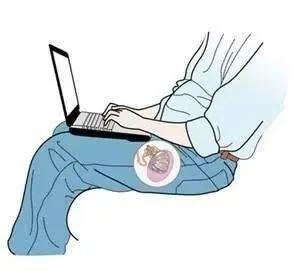
03 “Sitting” leading to decreased sperm quality—men trying to conceive should be alert
In many families trying to conceive, when the man’s checkup results come back, sperm motility is low, the abnormality rate is high, counts are low, and sometimes there is oligospermia, asthenozoospermia, or azoospermia. Often no major problem is found, but a key issue is overlooked: the testes’ heat dissipation.
The testes are heat-sensitive organs; the environment needed for normal sperm production is about 1°C–1.5°C cooler than body temperature. Prolonged sitting not only raises scrotal temperature but also compresses the spermatic cord, affecting blood circulation and ultimately impairing sperm production and maturation.
Not to mention that sitting all day on leather seats, wearing tight pants, or turning on the heater—these warming behaviors all "silently damage" sperm quality. If you want a healthy baby, the man needs to "sit in moderation" from now on.
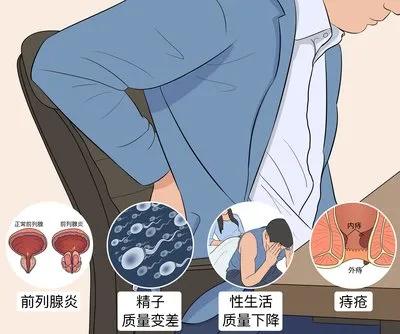
04 Pelvic floor muscle degeneration, leading to urinary incontinence, constipation, perineal heaviness and swelling, and other problems
Prolonged sitting can also lead to decreased function of the pelvic floor muscles. The pelvic floor muscles act like a "hammock," supporting the prostate, bladder, and rectum. When muscle strength weakens, urinary control can decline, manifesting as frequent urination, nighttime urination, or even stress urinary incontinence.
In addition, the rectum can also be compressed, affecting bowel movements and causing constipation and abdominal bloating; prolonged sitting can also impede blood return from the abdomen and lower limbs, leading to varicose veins, edema, and other problems.
When we say "sitting for long harms the body," it's not just spinal deformity or lumbar disc herniation — a deeper problem is that your entire genitourinary and reproductive system may become "disordered" as a result.
05 Director Yuan's advice: To fight prolonged sitting, it's not cushions that matter, it's action
If you have to sit for more than 8 hours a day, it's recommended to get up and move for 5–10 minutes every hour; you can simply stretch, march in place, or walk around the hallway. These seemingly small actions are very helpful for pelvic blood circulation.
Schedule 30 minutes of aerobic exercise each day, such as brisk walking, swimming, or cycling, to help improve cardiopulmonary function and blood circulation, and to strengthen pelvic floor muscles. Men preparing for conception can consistently do Kegel exercises, which involve contracting the anal sphincter and lifting the pelvic floor, to improve ejaculatory control and pelvic stability.
Avoid tight pants; choose breathable cotton underwear. At work, use a breathable seat cushion and avoid overly hard chairs that directly press on the perineum. If you're sitting for long periods while traveling, try to stand and walk during breaks.
If you already have issues with the prostate, sexual function, or sperm quality, don't hide your condition or avoid medical care—seek diagnosis and standardized treatment early so small problems don't become big ones. "Being motionless like a mountain" is the greatest misconception about health!