Dizzy but can’t find the cause? Don’t forget there’s a “balance device” in your ear
The room spinning, unsteady walking, feeling like you’re on a boat… anyone who has experienced dizziness knows how unpleasant it is. Many people’s first reactions to dizziness are “Is it my cervical spine?” “Is there a problem with my blood pressure?” or “Is there something wrong with my brain?”. Tests come back and everything may appear normal. At this point, you might want to ask your ears. That’s right—you read correctly, your ears!
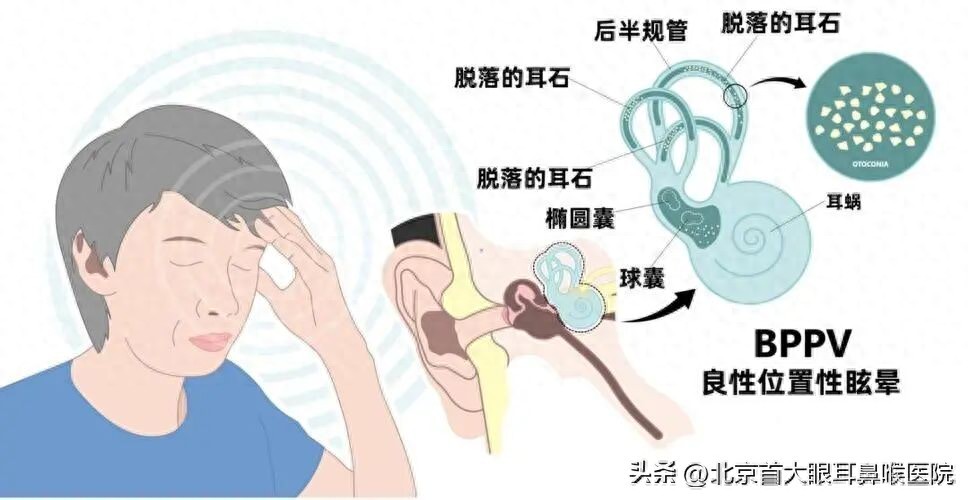
The ear is not just for hearing
In most people's understanding, the ear's core function is hearing. But in fact, our inner ear contains a balance system called the vestibular system:
Semicircular canals: primarily responsible for sensing rotational movements of the head (for example, shaking the head, turning around).
。
Otolith organs: contain many tiny otoconia attached to a layer of gel. These small stones are responsible for sensing linear acceleration and gravity.
When the head moves, these otoconia move accordingly, stimulating hair cells and sending precise signals about head position and movement velocity to the brain. The brain then integrates these signals with input from the eyes and the body to jointly maintain our balance.
If the otoconia become dislodged for some reason and fall into a semicircular canal where they do not belong.
When you turn your head or get out of bed, these dislodged otoconia roll in the endolymph of the semicircular canal under gravity, sending erroneous, intense rotational signals to the brain, while signals from the eyes and other parts of the body remain normal.
The brain cannot reconcile this conflict immediately, and it manifests suddenly as a severe, brief sensation of spinning.
This is the most common peripheral vertigo disorder—benign paroxysmal positional vertigo (BPPV).
There are several typical characteristics:
Related to changes in head position: triggered when getting up, lying down, turning over, looking up, or bending over.
Short duration: each episode of vertigo usually lasts only tens of seconds, generally not more than one minute.
Reproducibility: a specific movement will cause dizziness every time.
Not accompanied by other symptoms: usually no tinnitus or hearing loss.
Of course, besides benign paroxysmal positional vertigo, the ear can also cause these types of dizziness, for example:
Vestibular neuritis: usually caused by a viral infection, it presents with a sudden onset of persistent severe vertigo, accompanied by nausea and vomiting, but with normal hearing.
Meniere's disease: presents with recurrent episodes of vertigo, accompanied by tinnitus, a feeling of ear fullness, and fluctuating hearing loss that waxes and wanes.
This article is intended for popular science dissemination and cannot replace professional medical diagnosis. If you have related symptoms, please promptly seek care at a regular hospital.