Why Does Spleen Deficiency Lead to Excessive Phlegm?
Why does spleen deficiency lead to the production of phlegm? Isn't phlegm produced in the lungs?
Many people have this question. To answer it, we must start with the physiological functions of the spleen.
One of the most important physiological functions of the spleen is "transportation and transformation." What does "transportation and transformation" mean?
The digestion of food and the absorption and transportation of nutrients is a complex physiological activity involving multiple organs such as the spleen, stomach, liver, gallbladder, large intestine, and small intestine, with the spleen playing a leading role. The spleen functions to transform food and water into essential substances and transport these substances to all organs and tissues throughout the body.
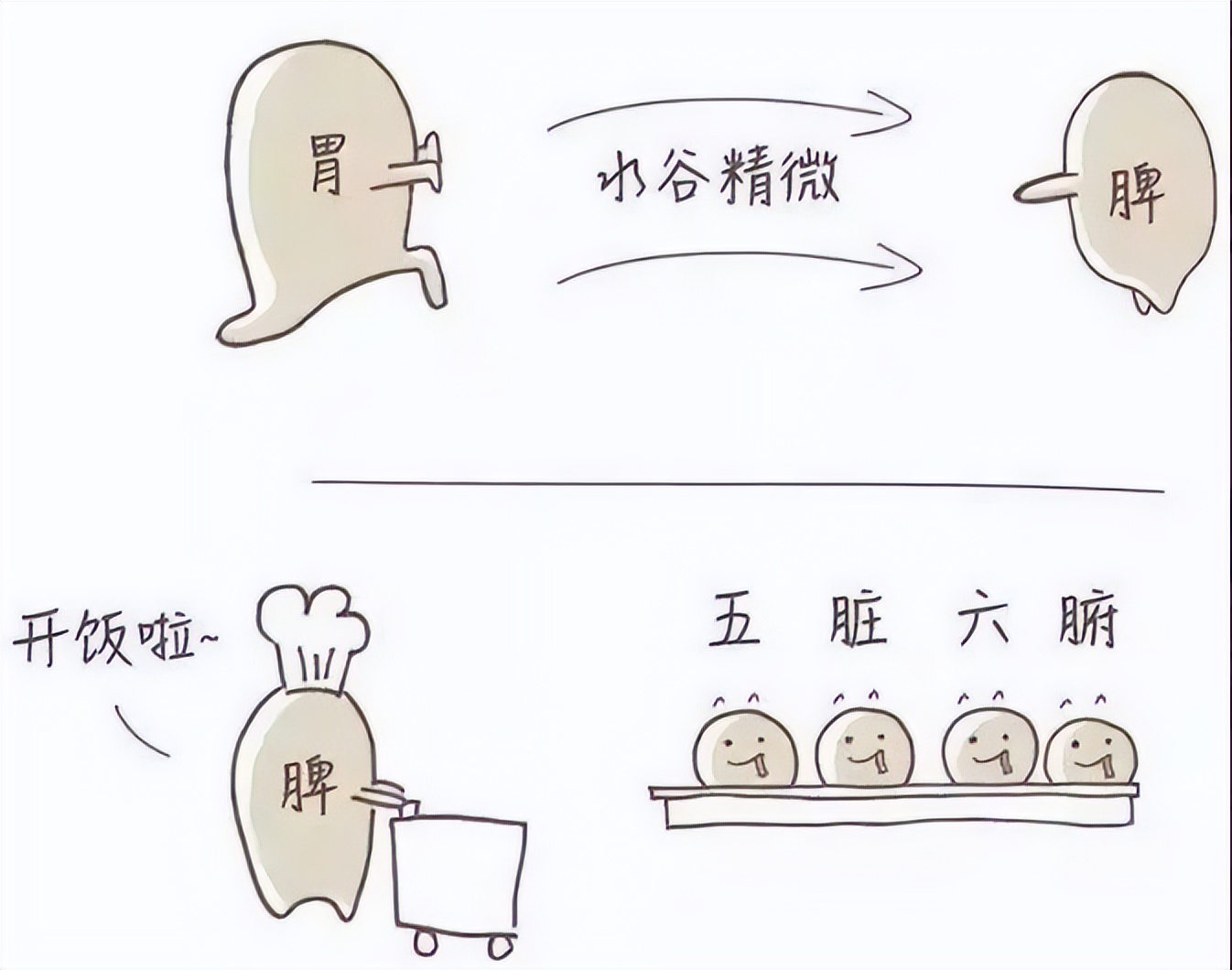
In human diets, water is essential. The spleen is also responsible for the absorption and transportation of fluids, regulating and maintaining the balance of fluid metabolism in the human body.
When the spleen's function of transporting and transforming dampness is normal, fluid metabolism operates smoothly. This ensures that all tissues in the body are adequately moistened without causing excessive dampness or fluid retention.
However, if the spleen's function of transporting and transforming water-dampness becomes dysfunctional—commonly referred to as "spleen deficiency"—fluid will stagnate in the body, leading to the accumulation of dampness. Over time, persistent stagnation of dampness can condense and form phlegm.
This is the theoretical basis for the saying, "The spleen is the source of phlegm production."
The saying "The spleen is the source of phlegm production" has a second part: "The lungs are the container that stores phlegm."
Body fluids are transported upward by the spleen to the lungs, where they are distributed throughout the body or directed downward to the bladder through the lungs' functions of diffusion and descent. Therefore, the transformation and transportation of fluids involve the coordinated participation of both the spleen and the lungs. If the spleen fails in its transporting function, leading to the stagnation of water-dampness and the accumulation of phlegm, it will inevitably affect the lungs.
Therefore, the location of phlegm disease is in the lungs, but its root lies in the spleen.
Thus, treating phlegm should not only focus on the lungs or merely resolve and expel phlegm; it also requires regulating the spleen.