"Treat disease before it arises, not after it has set in" — Bian Que tells you: treat diseases early.
Bian Que was a renowned physician during the Spring and Autumn and Warring States periods, later revered as the "Father of Medicine."
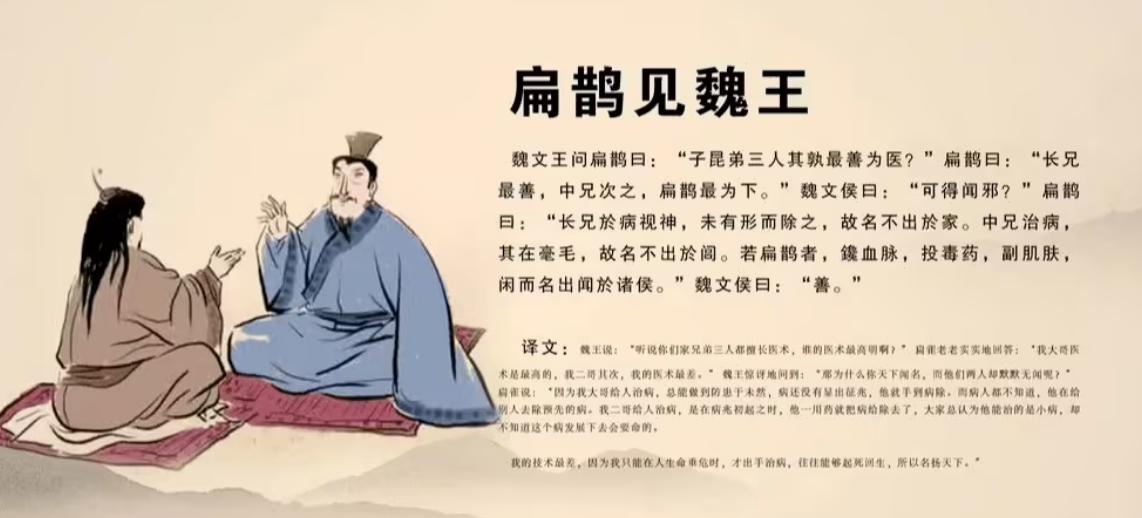
Once, King Wen of Wei asked Bian Que, "Among your three brothers, all skilled in medicine, who is the best?"
Bian Que replied, "My eldest brother is the best at medicine, my second brother is next, and I am the worst."
King Wen of Wei felt puzzled and asked, "Then why are you the most famous instead?"
Bian Que said, "My eldest brother treats illnesses before they even manifest. Ordinary people are unaware that he can eliminate the root cause in advance, so his reputation does not spread. My second brother treats illnesses at their onset, and ordinary people think he can only treat minor ailments, so his fame is limited to his village. As for me, I treat illnesses when they are most severe. People see me performing acupuncture, applying poultices, and brewing medicinal soups, and they believe my medical skills are extraordinary, which is why my reputation spreads far and wide."
There are many legends about Bian Que in history, but his two elder brothers are only mentioned in his own narrative. This is likely the power of fame.
The *Yellow Emperor's Inner Canon* states: "The superior physician treats diseases before they manifest, not after they have fully developed." This means that a skilled doctor intervenes before the illness becomes apparent, rather than waiting until it has progressed to a severe stage.
"Treating diseases before they manifest" is a distinctive concept in traditional Chinese medicine, which has always been valued by physicians throughout history. However, as Bian Que pointed out, "treating diseases before they manifest" does not bring any fame, causing many outstanding doctors to be lost in the vastness of history without leaving a single word behind.
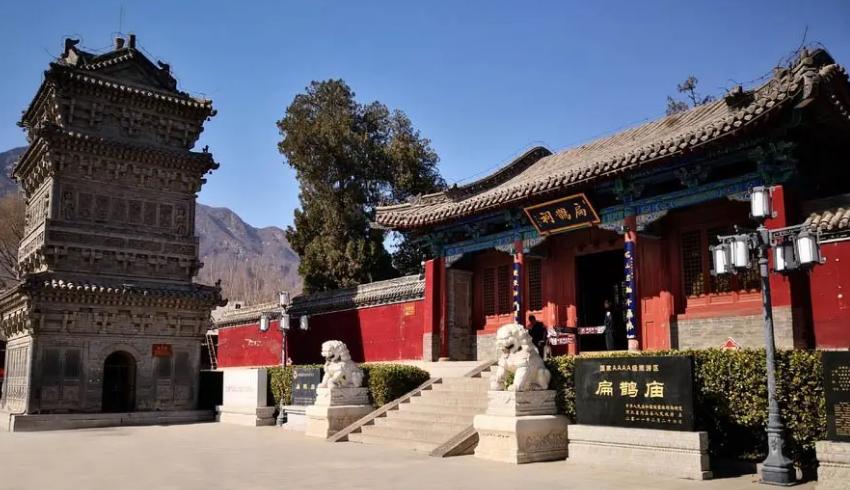
Bian Que traveled to various states practicing medicine, and stories of his treatments were widely circulated at the time, earning him great fame.
One day, Bian Que arrived in the state of Qi and was granted an audience with Duke Huan of Cai.
This story is recorded in "Han Feizi"; this Duke Huan of Cai actually was not the ruler of the State of Cai—it should refer to Duke Huan of Qi. Moreover, this "Duke Huan of Qi" is not the same as that "Duke Huan of Qi"—this "Duke Huan of Qi" is not the Duke Huan of Qi who was one of the Five Hegemons of the Spring and Autumn period, but rather Tian Wu, the third ruler of the State of Qi after the Tian clan replaced the Jiang clan during the Warring States period, historically known as "Duke Huan of Tian Qi."
After Bian Que met Duke Huan of Cai, he stood before him for a while and then said, "Your skin and muscle texture show signs of illness; if left untreated, I fear it will worsen."
Duke Huan of Cai said, "I am not sick." After Bian Que left, Duke Huan of Cai told the people around him, "Doctors enjoy treating healthy people to demonstrate their skills."

Ten days later, Bian Que visited Duke Huan of Cai again and said, "Your illness has already progressed into the muscles; if not treated promptly, it will become even more severe."
Marquis Cai Huan paid him no heed. After Bian Que left, Marquis Cai Huan was displeased.
Another ten days later, Bian Que visited Marquis Cai Huan again and said, "Your illness has progressed to your stomach and intestines. If not treated promptly, it will become even more severe."
Marquis Cai Huan again ignored him. After Bian Que departed, Marquis Cai Huan grew even more displeased.
Another ten days later, Bian Que caught sight of Marquis Cai Huan from afar, turned around, and fled.
Marquis Huan of Cai found it strange and specially sent someone to ask him.
Bian Que said, "When a disease is between the skin and the muscles, the power of herbal steaming and hot compresses can reach it; when the disease is inside the muscles, acupuncture can treat it; when the disease is in the intestines and stomach, herbal decoctions can cure it; when the disease is in the bone marrow, that falls under the jurisdiction of the gods who govern life, and doctors are powerless. Now that the disease is in the bone marrow, I will no longer request to treat him."
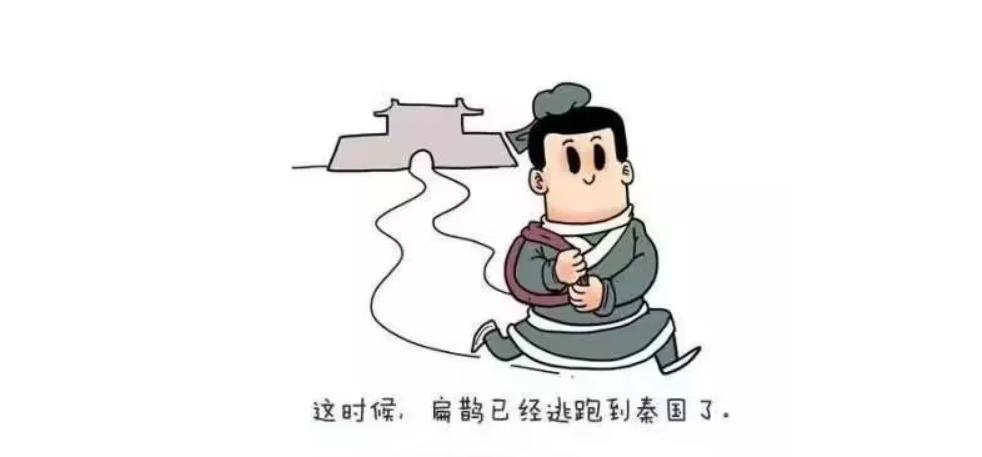
Five days later, Duke Huan of Cai felt pain in his body and sent someone to look for Bian Que, but Bian Que had already fled to the state of Qin. Duke Huan of Cai subsequently fell ill and passed away.
Zhang Zhongjing's "Treatise on Febrile Diseases" from the Han Dynasty summarized the progression of externally contracted illnesses from the outside to the inside and established the "Six Meridian Syndrome Differentiation" system. The development and changes of diseases generally follow the pattern from the exterior to the interior, often starting on the body surface with mild symptoms at onset. Over time, the disease gradually progresses inward, and symptoms become increasingly severe.
Doctors prefer to treat diseases at their mild and superficial stages. However, patients like Duke Huan of Cai are not uncommon in clinical practice. As the disease progresses, doctors employ various strategies to halt its further development. But if the disease truly reaches its most severe stage, even if Bian Que were to be resurrected, he could only "flee from Qin."

In modern times, we summarize the concept of "preventive treatment" to mean not only intervening before a disease manifests but also preventing its transformation after it has occurred—namely, "preventing illness before it occurs" and "preventing progression after illness has developed."
Preventing illness before it occurs
Preventing disease before it occurs actually encompasses two points: one is paying attention to health maintenance in daily life to prevent the onset of disease; the other is treating the disease before it manifests, eliminating it in its early stages.
The Huangdi Neijing contains extensive discussions on health preservation and proposes many effective methods. For example, in the first chapter "On Ancient Innocence," it advocates for daily routines that adapt to the changes of the four seasons.
Diseases do not occur suddenly; changes within the human body actually begin before the disease manifests. Treating the disease before it fully develops allows for quick elimination of pathogens since the condition is mild, and the patient will not experience any discomfort.
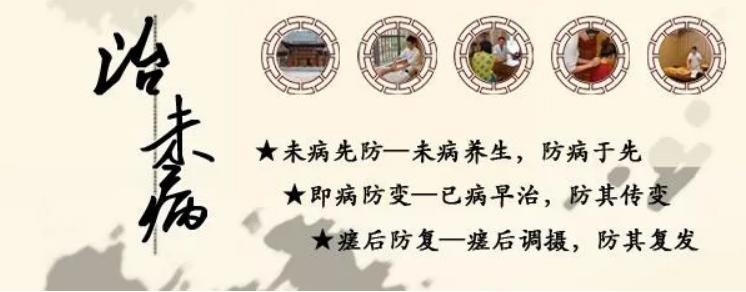
Preventing Disease Progression
After the onset of a disease, it is essential not only to treat the illness but also to prevent its progression or internal transmission. In *Treatise on Cold Damage Disorders* (*Shang Han Lun*), there are numerous methods to prevent the transmission of diseases. For instance, when a Taiyang disease occurs and shows a tendency to progress to the Yangming channel, acupuncture can be applied to points along the foot Yangming channel to prevent the disease from advancing internally.
Furthermore, diseases can transmit between organs. As stated in *Essentials from the Golden Cabinet* (*Jin Gui Yao Lue*), "When liver disease is observed, it is known that the liver transmits to the spleen, and the spleen should be fortified first." According to the theory of the five elements, the liver corresponds to wood, while the spleen corresponds to earth. Since wood restrains earth, liver diseases are prone to affect the spleen, leading to pathological changes in the spleen. Therefore, when liver disease is detected in a patient, the principle of "knowing that the liver transmits to the spleen" should be considered. By strengthening the spleen's function proactively, the transmission of the disease can be prevented.

The "Yellow Emperor's Inner Classic" states: "The sages do not treat those who are already ill, but rather prevent illness before it occurs; they do not govern those who are already in chaos, but rather restore order before chaos sets in." In the traditional philosophy of ancient China, the occurrence of events always has its underlying causes, and nothing changes without reason.
Treating illness is like governing a nation; before any turmoil occurs, the root cause of the turmoil must already exist. The "sage" governs the country by eliminating the root cause of turmoil before it happens, thereby preventing turmoil from occurring and allowing the people to live and work in peace and contentment.