Sudden Amenorrhea at 30? Tests Reveal Premature Ovarian Failure! TCM: Root Cause Lies in the Kidneys, with Two Distinct Treatment Approaches
We frequently receive messages like: "I'm only in my thirties, but my period suddenly stopped. Tests showed premature ovarian failure - what can I do?"
From a Traditional Chinese Medicine perspective, premature ovarian failure doesn't occur suddenly but results from progressive ovarian function decline, with the core issue rooted in "Kidney deficiency." Clinically, we see two main types requiring different treatment approaches:
1. Liver-Kidney Yin Deficiency: When deficiency leads to "drying up" of menstrual blood, accompanied by stagnation
The kidneys act like the body's "energy reservoir," storing the foundation of reproduction and development; the liver is the "blood bank," regulating menstrual flow. These two share an exceptionally close relationship—kidney essence nurtures liver blood, and liver blood transforms into kidney essence. Neither can function without the other.
For these women, amenorrhea is often "a deficiency accompanied by obstruction."

The liver and kidneys are already deficient, with severely depleted qi and blood. Combined with qi deficiency that fails to propel blood circulation, this easily leads to blood stasis, completely blocking the menstrual passage.
Treatment must follow the principle of "tonifying first, then regulating" — as traditional Chinese medicine practitioner Zhang Jingyue said, "The best way to regulate is to replenish first." First replenish kidney essence and liver blood sufficiently, then gently promote blood circulation. When the uterus and the Chong and Ren meridians receive proper nourishment, menstruation will naturally return on schedule.
II. Spleen-Kidney Deficiency: Congenital and acquired "weakness" resulting in inadequate qi and blood production
The kidneys represent the innate "foundation," while the spleen serves as the acquired "food processing plant." Only with sufficient kidney qi does menstruation have the driving force to occur; only when the spleen functions properly can it produce enough qi and blood to support menstruation.
If the spleen is deficient, the body cannot properly digest ingested food, causing qi and blood to become like "water without a source." With no blood to flow in the uterus, menstruation naturally ceases.
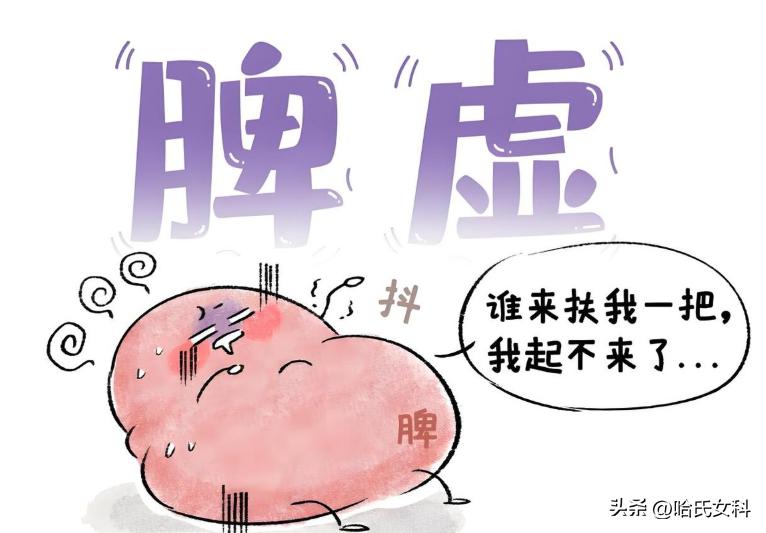
In such cases, a dual approach of "warming and tonifying the spleen and kidneys" is required: while replenishing the innate kidney qi, also strengthening the acquired spleen yang to ensure blood and qi can be sufficiently produced and effectively circulated. At the same time, gently clearing any blocked pathways allows the abundant qi and blood to flow smoothly, gradually restoring menstruation.
Ultimately, premature ovarian failure is not irreversible—the key is identifying your specific "deficiency type."
What menstrual abnormalities do you typically experience? Feel free to share in the comments, and we’ll help analyze your situation.